


There was a man—we will call him the scribe, though he did not always bear this title, and has borne many more since—conceived under a full moon, born in the city of Hermopolis, and raised with a pen in his hand. It may be that the gods always destined him to fulfill this role, but providence is difficult to divine, and remembrance provides a clearer trajectory of one’s life. If one were to ask the scribe, it is likely he would say that since he was born, he had wished to die. In truth, this might be an exaggeration, as he did not know what death was until he was four years old, when he had seen a serpent strike a jackal and watched as its companions left it to perish; and when the pet cat who came and went from their home never came back. He learned about the gods first through death. Whenever he witnessed a brittle scarab on its back, or a vulture tearing at a small mouse beneath its clawed foot, he would ask his father to tell him again where they went.
To meet the gods, his father would tell him, and piece by piece over his childhood he formed a clearer and clearer map of the journey to the afterlife, the path to the solar barque where the sun god Ra passed through the realm of the underworld, the Duat, collecting the souls of those judged worthy of attaining rebirth and eternal life alongside him. There follows three steps that one must take to gain entry to the afterlife: (1) One must pass through the twelve gates, nine of which are guarded by demons and gods before (2) descending to play a game, and should one win this game, they may pass on to (3) the Hall of Ma’at, the room of final judgement where one’s soul was weighed by the jackal-headed god Anubis against a feather. Only if the soul was as light as a feather would one finally be reborn into eternal life and be allowed to live among the gods in the Field of Reeds. Should one’s soul be too heavy, they would be cast into the maw of Ammit, eater of hearts, a foul beast who digested souls in darkness for all eternity.
There were instructions passed on to the dead, left in their tombs after they died in order to guide them through these trials; such as the demons at each gate: each one had a title, but every being had a true name, one that was kept hidden, for names had power. One was to approach these gates and speak the true name of each demon in kind to gain power over them and open the gates. This was knowledge passed on to all souls at their death.
What a great adventure death seemed to one so solitary as the scribe! It was true that one did not easily pass through the trials of the afterlife, but this and the life after, the life where one might walk among the gods and never truly be alone, this was the most sublime of aspirations. With this in mind, he lived his life. And so if his parents had told him to do something, he did it; when he found someone in need, he helped; and when faced with a choice, he chose the right one. He lived this way and kept his soul light, free from weight.
When he was 6 years old, his father drew from the wealth he had collected as a priest and from his wife being a cousin of a cousin of the royal family, and had him placed in an institution to begin training as a scribe. The city in which he lived, Hermopolis, was home to the Temple of Thoth, the scribal deity. It was known that Thoth was scribe to the gods, particularly to the god Ra: where Ra was the sun, Thoth was the moon; Ra the first pharaoh, and Thoth his loyal advisor. It was really quite reasonable that his father, a priest of Thoth, would set his son to become a scribe in the hopes of accomplishment.
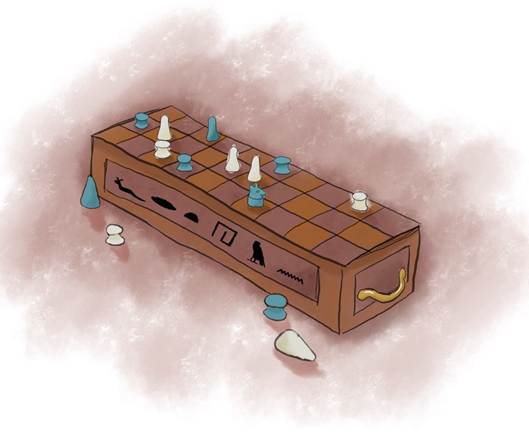
Become a scribe he did, and in his free time, he played the game. The game which one would be made to play before gaining entry to the hall of judgement in the afterlife, the game in which one was expected to play for and against one’s own soul at the end of life, was called senet. He, and all other Egyptians, knew this by heart: 30 squares, each a representation of one’s journey through life and death; 10 pieces, 5 for each player; the goal to reach the final square—the House of Ra. At the outset, he had simply enjoyed playing the game. He played it in the sand or on the wall with his friends. He did this almost unthinkingly, after finishing a chore or a task, he simply turned to the board and began playing. His sister and mother always played with him, but when he left home for further study at the House of Life in Thebes, there came a time when his peers became too weary of defeat and refused to play the game with him anytime in the near future. It was around this time that the scribe, left with no one to play with, stopped playing for a time. It was also around this time that he began working as a scribe in the temple under the guidance of a most adept mentor shortly before graduating.
He was 14 years old when news of the eldest prince’s death began to circulate, and if he had not heard about it from his fellow workers, he certainly was made aware of it when his mentor received a message from the pharaoh demanding he hasten immediately to begin preparation for the funerary rites. The scribe was taken along with a handful of others to aid in the ritual, arriving by cover of night at the palace where they were led by firelight to the body of the boy prince. He lay still, his features at peace, perhaps already beginning his journey to the Field of Reeds; the scribe wished him luck. As his mentor discussed in hushed tones with the staff, two shadows stood behind a pillar, just outside firelight, a boy and a girl. Only when the light flickered did the scribe see the fear carved into the body and face of the boy, the confusion in the brows of the girl. No other person in the room, it seemed, noticed the two: the scribe said nothing and when he was called back by his mentor, he attended him readily.
*
The process of mummification had begun, a process which often spanned a significant length of time. During this time, the scribe was among those commissioned to produce a rather illustrious book of the dead for the late prince. He remained in Thebes as he worked on this, at residence in the Temple of Amun-Ra, very near the pharaoh’s palace. Perhaps due to his relation to the royal family, he had been granted wider access to walk around the palace courtyards when he was not working. It had been less than a week since the eldest prince’s death when the scribe sat outside beneath the shade of the columns in the lesser courtyard, cleaning his pen in silence as he did most evenings. At once a sudden commotion of dueling voices rose from the entrance to the palace nearest to him. Of this noise, he could hardly make out the words but for one “mother, please,” and another “…inside for weeks…because I care for you,” before a boy stumbled into the courtyard. Even from this angle, the scribe recognized him as the boy from the first night who stood with the young girl beside him—the young prince and princess, the remaining siblings of the crown prince. He watched as the boy—the prince—released an exasperated sigh before lifting a hand to his forehead and casting a curiously hateful glare to the setting sun. Only a moment later did the prince’s sharp gaze abruptly land on him.
“You, scribe,” he barked, all anger, “what do you look at?”
The scribe mumbled an answer in return, casting his gaze down, all of which seemed to sate the prince enough for a silence to descend between them as the sun fell and the shadows grew. He watched as the scribe fumbled with his pen. After a time, the prince spoke again, a softly cadenced sound: “You prepare the texts for my brother, yes?”
“Yes, prince. I prepare him for his journey.”
The prince looked down upon the scribe as he stood before him, his eyes dark. “They will not let us close to him, my sister and I.”
It was rare that the scribe spoke to anyone besides himself, his vocation was a solitary one, and much of his work was performed in silence. As it was, he had very little idea how to respond to this statement, but simply said, “he looks as if he is sleeping,” and evidently this was the right answer because some of the hardness left the prince’s face and the scribe himself felt the tension ease.
Lowering himself to sit down near the scribe, the prince gazed forward. “Scribe,” he said, “how well do you keep secrets?” He asked this, though before the scribe could make an answer, the prince seemed to think better of it and simply dismissed the conversation.
After a long moment, the scribe ransacked the shelves of his mind for something to say. “We are cousins, you know,” he offered.
The prince’s frown lifted before a stern look overtook his face again. “I have no cousins.”
Then the scribe rushed to explain himself, that perhaps they were more distant than cousins but were cousins all the same, that his mother was a descendant of a great great grandfather they shared. As the scribe spoke, the prince softened still.
“I did not know you existed,” said the prince. “They are saying,” he began, “that my sister, she has the same illness inside of her that my brother had. She has been ordered to remain in bed, I cannot see her. This illness—they will not say it, but they cannot cure it, though they will lie and pretend to try.”
The scribe had never before and perhaps has never since been confronted with such an instance of absolute fear and uncertainty of what to say. The prince, for his part, appeared lost in a particularly distressing thought, nails digging into the brick beneath him.
It was with a tone of voice more unruffled than he felt that the scribe asked, “would you like to play a game?”
The prince’s dark gaze did not move, his body a rigid statue so motionless that it almost seemed he had not heard him. Entirely sure that he had finally said something wrong, the scribe began to shift, ready to dismiss himself. He only stopped when an answer came.
“Which game?”
*
The prince was truly awful at the game of senet. If he did not fail to foresee a move, then the outcome of his die roll was unlucky, and so on. He knew this, yet he still played with the scribe, who won each time. When the prince was younger, he had played more often with his older brother, but as his brother grew older, there was less time to do so. The prince grimaced as he lost. With the scribe’s help he became marginally better, though he still failed every game. He would, however, snap at the scribe if he noticed him intentionally playing poorly.
Do not let me win, the prince would pin him with dark eyes.
You are playing very well, the scribe might offer a mollifying smile, and when he made this comment the prince often looked away, back down to the board with a fever in his cheeks and made a hasty move.
So passed the next several weeks: the scribe worked in the temple for great lengths of time each day on funerary texts and preparations, and when he was not working, they played senet together. Never had the game felt so important to the prince than now, when he knew that his brother might be playing the same game on the other side. Suddenly, death seemed a very real thing to the prince.
While he was not previously aware of the scribe’s existence, the pharaoh’s vizier—who kept himself well informed on the pharaoh’s bloodlines, which were ever dwindling—was quite aware. Seeing the closeness which developed between the prince and scribe over this time, the vizier watched them: the scribe hurrying from the temple to the palace each evening; the prince making his way to wait outside the temple entrance if the other boy was being kept too long, the former scolding and snatching the latter’s hand to tow him to the palace; and should the vizier have ever caught glimpses of them playing the game, he might have seen a tense game—the prince with nostrils flared and jaw cut hard, eyes on the pieces, and the scribe battling with every fiber of his being to contain a laugh when the prince finally threw the pieces at the wall—but he might have been equally likely to see a quiet game—the scribe with his legs crossed, the way he had been trained to sit when he wrote, and the prince lying on his side, his elbow propping him up and contemplating his next move as he listened to the other boy talk of things which interested him; insects, poetry, astronomy (especially Thoth, lunar god of scribes) and the like, though the one thing they never spoke of was death.
The funeral came and went. Afterwards, though he had not previously met the man, the scribe was offered a position in service to the vizier to remain at the palace. The prince and the scribe passed much of their time together: as the scribe now worked within the palace, the prince often sat with him while he worked and talked about his own training which he had begun after his older brother’s passing; and when his sister’s condition seemed to improve after several months, the prince brought him to introduce to her. Her bed was covered with half a dozen small crocodiles made of reed, which she paused making when they came in. The princess was far better at the game than her brother, who, after losing a few rounds against his sister, seemed to lighten up at the prospect of losing. She laughed openly at him. The scribe came to like her.

The scribe might have played with her more often after the prince left had he had more time, but in the absence of his presence there was little excuse for the scribe to slack off. The incursions in the lower valley by the neighboring Hyksos king had provoked skirmishes on the borders, an occurrence which had been ongoing since before the scribe’s memory. This new resurrection of conflict had prompted the vizier to advise the prince to gain practical skills in strategy and diplomacy closer to the action. Should the Hyksos be left unattended, Thebes might be swallowed whole by the king to the north, the pharaoh dethroned. It was a bright day like all the rest, the day the prince packed to leave, unsure how long he would stay away, but assured the scribe and his sister that he would not be long.
For the next two years, the scribe worked dutifully under the vizier’s supervision; he learned well the laws, administrations, and minutiae which concerned the dynasty. In his free time he might play the game by himself (though this normally appeared to a passerby as a boy shuffling pieces aimlessly about a board) or sometimes he might play with the princess, whose room always smelled of Kyphi now—honeyed and medicinal incense. Not often, but rarely, they spoke about the prince when they played.
“Yes,” the princess answered when the scribe had asked if the prince had always played the game poorly. “He is naturally awful at certain things.” She laughed in the way only a sister can. “Ever since he was small. When he was very young, before I was born, he would make the most distressing cries anytime he was left alone in a room. And our eldest brother was much better at reading poetry aloud than him. He is good at a great many things, however. Besides the game, I think he has always been a fast learner.” She made a sniffing sound and the scribe offered her a cloth from her bedside, his hand brushing a toy crocodile lying on the table—it was the only animal she knew how to make. “Oh, you can take one if you want. I think I’ve made too many now.”
*
The prince arrived back at the palace three days after the pharaoh his father died. The scribe had not seen him for two years and though he looked much changed, the scribe recognized the boy he had spent hours staring at over a senet board. And it was easy enough for him to recognize the prince, now a man who ascended the palace steps. There was a commotion as the prince’s year of coronation began, as he transitioned until the scribe and the region no longer thought of him as a prince, but a pharaoh. It was a handful of passing words from the vizier that kept the scribe out of the pharaoh’s sight for a time: The pharaoh will have no time for games now he is returned. The scribe did watch, however, as he was coronated by the high priest, as he grasped the crook and flail in his palms and was made divine, the son of the sun, beads of sweat running down his back. It turned out the vizier had been right; banquets and festivities overtook the city, so much so that it seemed the pharaoh and his advisors had hardly a moment of respite. The scribe spent his days collecting and noting the figures and information from the sessions which were held between the pharaoh and his advisors.
One evening, the scribe was making his way apace down the emptied halls, exhausted from the day’s work, when a deep voice cut through to him and he found himself accosted against a column.
“Scribe.”
The pharaoh himself appeared in front of him and the scribe could not stop his tools from falling through his fingers. Unbothered by the clatter on the brick, the pharaoh grasped his wrist firmly, his gaze unwavering. “Where have you been?”
The scribe, no particular thought in his head, bowed and began reciting honorifics. If he had looked up, he might have seen a strange look on the pharaoh’s face, but he did not.
“Enough.” The pharaoh stopped him. “You visit my sister but not me?”
“There is little time now for unimportant undertakings.”
“This is true,” he answered, but did not move to leave.
“The sun has little time for games,” said the scribe.
A biting remark—“Who told you this?”—then angrily: “If I am the sun, then you are the moon, orbiting these halls, though never coming close.” He paused, as if contemplating something. “Yes, that is what you are, the moon.”
*
Now the scribe sat in on meetings between the pharaoh and his advisors, all of whom were remarkably exultant to be working in the service of the new pharaoh. The vizier had taught the scribe perhaps too well the art of statecraft and the scribe furrowed his brows at a handful of documents from the sessions: a small but noticeable increase in taxes on artisans and farmers, a bit more gold directed towards the temples. When this policy was discussed by the scribe to the vizier, the latter expressed great satisfaction with the new actions, and the former considered that perhaps he was wrong and this course was the correct one.
This was his position for a time, until one morning when he sat in on a trial, as he often did, taking notes beside the priests who presided over the event. The scribe did not look up, but instead wrote what he heard: two farmers entered, one of clear guilt and the other of certain innocence, the one accused of stealing crops from the other’s harvest. Though this quickly changed when the innocent was loudly accused of grave robbery by the other party, who showed to the priests gold coins which he proclaimed to have found littering the other man’s doorstep and as simply as this the innocent became the guilty. The alleged grave robbing farmer was sentenced to have his hands cut off and the scribe did not think he had ever seen trials move as fast as they now did. Could it be, the scribe thought, that this is justice?
The next day, however, when he saw the pharaoh’s hand clench while he was being briefed on the cases of the previous day, the scribe felt a flicker of doubt the other way. Perhaps the verdict might have been revisited, the farmer might have kept his hands, had the princess not passed quietly in her sleep a day later.
A week had passed since either of them had last visited her, increasingly busy with duties, and the scribe finally picked up a crocodile off her floor once her body had been removed from her bed. The pharaoh dutifully directed her mummification and burial preparations, the very image of composure and respect. He did not attend briefings with advisors as frequently, though this was likely due to his time being even further occupied now, and the priests took little issue with the increasing absence of the pharaoh.
It was during one evening when the scribe and pharaoh were sat in the latter’s chambers, playing a game of senet, that the pharaoh lost another game. The scribe watched his movements and rolls of the die. Luck was required in the game, and this, he thought, was something like life. It was something like death, too, as a bit of luck was required to gain the goodwill of the gods. Hunched over the pieces, he said as much to the pharaoh who sat straight-backed, gazing at the board absently.
“I suppose all is lost then,” murmured the pharaoh.
“Is this so, son of Ra?” The scribe smiled and tilted his head to catch his eye.
The pharaoh’s lips twitched, but he looked away. “You laugh, but it is true.”
“You are the luckiest of all men. Last of the bloodline, chosen by gods.”
A noise of irritation from the pharaoh. “Do not remind me; the vizier speaks his concern everyday on the matter of marriage.”
“It is a significant thing, to choose a wife. You should be eager.” The scribe gibed, waiting for the other man to flare up at him.
Though the only thing the pharaoh said was, “I should be many things that I am not.” As he spoke these words, the slightest droop in his shoulders became the only thing the scribe could focus on; the darkness beneath his eyes, the hollow of his cheeks. Suddenly, the scribe finally noticed that he did not look very much like the sun anymore.
Once he realized this, the scribe attempted to visit the pharaoh each week, if only to check for himself that he did not look any worse than he had the week before. This business became more difficult after a number of months, the vizier requesting more copies of a document, a priest or advisor asking for an audience with the pharaoh about a small revolt over grain shortages in a lower-valley city. Even if these inconveniences were not present, the conflict in the lower-valley by the Hyksos king in the north had renewed, and news of poorly defended towns on the outskirts of the kingdom being raided and seized reached Thebes. Rule of the entire lower-valley and yet their ambitions remain unsatisfied…overtaken the city of Huw in the west…surrounding…they will not cease until they reach the capital, whispered the priests who had previously advised moving soldiers away from the border cities to help ease the grain shortages, though perhaps those inhabitants of the cities would have preferred the shortages to the violence that the Hyksos brought.
At the end of a particularly monotonous meeting one evening—consisting of various minor issues which the pharaoh listened and nodded along to—the scribe had nearly reached his chambers when he realized he had not given to the pharaoh his copy of that meeting’s decisions. He turned around and upon arriving at the chambers of the pharaoh, was met by his two guards outside the door, both of whom the scribe had made acquaintances with from countless times of arriving to play the game with the pharaoh. This time, though, upon requesting entry he was turned away.
The pharaoh is accepting no audiences tonight, the scribe was told. In truth, this was strange, as the pharaoh often kept late hours. When the scribe said as much to the guards, he was rebuffed again in a much more tense manner than they had ever spoken to him before, until he nearly acquiesced and handed the copy to the guards, turning to leave. Then a noise, something shattering, came from the chamber of the pharaoh beyond. This stopped the scribe’s feet and he turned to look back at the guards.
“The pharaoh threatens pain of death to any who enter,” one guard warned, though both of them looked to him with imploring eyes.
It took merely a moment for the scribe to pass between the guards and enter the chamber, the guards unmovingly watched him. The sun had just set and only two or three oil lamps remained upright and lit. A vase lay smashed on the floor, water seeping into the brick below; table upturned, the leg of a stool broken; gold bracelets and necklaces cast about; oil dripping down the wall; cushions flung; sheets torn from the bed; and in the middle of it sat the pharaoh, on the floor, all alone. His chest heaved, a tormented expression on his face.
The scribe began towards him, a careful journey over pottery shards, the pharaoh’s eyes tracking his movements.
“You threaten your servants with death?” The scribe spoke as he toed a ring out of the way.
“It is the worst fate I can imagine.”
“There exists an infinite amount of fates worse than death.” Past shards and wood he stepped. “You have failed to keep out the rabble from such narrow-mindedness and now I am here.”
The pharaoh stared somewhere quite far away and looked as if he didn’t listen, but he always did. Only when the scribe lowered himself to sit beside him did the pharaoh truly look at him.
“This kingdom,” the pharaoh inhaled, “swallows itself whole, eats itself alive. The vizier tells me nothing is amiss, that it is the gods’ will that I remain pharaoh. Yet I hear his words to the priests when they turn their backs: the people are hungry; the enemy comes, their intentions clear; there is not a soul left within or without that does not silently pray for my death.”
“This is untrue. It has not been your fault—”
“It has been only my fault.” The pharaoh, normally so cowing a presence, now without his gold and attire seemed to curl in on himself, head bowed and ribs tensed. His eyes traveled to a small toy crocodile that lay upturned at the other end of the room. “The gods—they hate me. Everything that ever meant something to me has been pried from my grasp, year after year, is there no reprieve?” His voice broke then for the first time and something in the scribe’s chest rent in two.
It was true that the pharaoh had lost plenty in his short life; it is no small thing to feel the absence of parents and siblings alike in one’s heart, to be left behind with little guidance. But all of these loved ones, the scribe thought, were no more than waiting for him alongside the gods on the other side of death.
When the scribe dared reach out to bring the pharaoh’s chin up and to tell him these words, he found tears in his eyes.
“I do not want to die.” The pharaoh shook as he spoke, “I am not what I should have been. My being is weighed down by countless injustices befallen upon this kingdom in my name. My soul is too heavy—I feel it.”
If he died, the pharaoh thought, he might be able to complete the first step of the afterlife, to pass through the 12 gates guarded by demons; he might even, though he was pitiful at it, be able to scrape by in playing the board game against his own soul; but even if he managed to complete these two tasks, he knew that he stood no chance in the final hall of judgement, that his soul was far heavier than a feather, that he would indisputably be denied entrance to the Field of Reeds where his loved ones walked, that his soul would be cast into the jaws of the beast Ammit, lost in infinite darkness.
And when the scribe beheld the pharaoh, rather than disavowing these claims, he began a descent into a reflective state: there is still time, there is still time, he spoke these words aloud and found himself overstepping, grasping for the pharaoh, his tears running through the scribe’s fingers, one may always lighten their soul. The scribe placed his back to the world and spoke of justice and strategies and administrative courses that he had never been asked for, sentiments he had kept to himself, proposals to save a lost kingdom, to save a lost soul.
The scribe felt he had convinced him that all was not lost when the pharaoh’s upward gaze on him softened. “I see,” breathed the pharaoh, “blindness has been my greatest offense, I see now. There may be something I can do for this kingdom.”
*
The vizier was not resentful when the pharaoh ordered the scribe to replace him, though perhaps he knew something that no one else did because he packed and left Thebes quietly with little trouble, a curious reaction from a man who had spent more than twenty years of his life in this role. As the scribe assumed his new position as vizier, he was surprised to find little resistance from the priests, as well. This new role, he found, seemed to suit him rather well: there was no need to train or inform him on policies, for he already knew them by heart. He had risen from his former role hunched over scrolls and now stood beside the pharaoh, and when he spoke, he was listened to. Not since they were children had the scribe and the pharaoh spent every day together, but now, no matter the time of day or night, one could be sure that if they went looking for the one, they would also find the other.
The pharaoh, perhaps for once in his life, had made the right decision; and much the same as everything else in his life, he had made it too late. If there are things that grow better with time, then there must also exist those things which are worsened by it, and if a great many administrative issues were written away with the flick of a pen from the scribe, the Hyksos invasion was one impending calamity that none could hold back. Unclear was it to many, just why after decades of steady encroachment, the king of the Hyksos had decided to advance so viciously now, though it was not difficult to hazard a guess: a waning kingdom with a verdant young ruler and no future heir in sight, some may argue, was nearly begging to be seized.
As the enemy approached Thebes, suggestions to flee were rebuffed by advisors. There was nowhere to flee to, all knew this; the Kingdom of Kush to the south, while not outright hostile to the pharaoh, would also not offer refuge to such a person as he.
Each day, the pharaoh met with the scribe and formulated unparalleled strategies and for weeks, it was the scribe’s habit to pass between the guards and enter the pharaoh’s chambers each evening where the pharaoh poured over maps and documents, and when the scribe reemerged, features always more discomposed than when he entered, he took to the empty meeting room after all others in the palace had retired to bed, and he lit an oil lamp. Much as the scribe might try, his hours spent awake by firelight crafting orders and directives for supplies and military reinforcements in the affected regions proved worthless. The pharaoh, when he was not overburdened by pernicious councilors, devised truly astute tactics, though there is little tactics can do against overwhelming numbers. The enemy grew closer, an indomitable serpent which wound its path here then there, winding a coil ever tighter around Thebes. Though he did everything right, it seemed that the scribe could solve every problem except this one.
To his credit, the scribe stayed as most others soundlessly departed from the palace—the flight of several priests from Thebes might have been punished had there been enough manpower left to spare tracking them down. When the news reached the palace that the Hyksos had reached the border of the city, there was little life left within the halls.
In the dark hours of the morning on the day of his death, the scribe sat still beside his lamp in the emptied meeting room, gaze unwavering from the work in front of him. He sensed the pharaoh in the doorway before he saw him, standing just beyond the light of the lamp.
“It is early,” stated the scribe, and when he looked up he found the pharaoh, his guards just outside the room. “Should you not be asleep?”
The pharaoh did not make an answer to this, but instead gazed at him with such a look that the scribe knew he had already seen it, too: when one stood at the palace steps, the fires could not be heard yet, but they could be seen; a flash of an arrow; a lick of smoke rising from the city below.
“I suppose you know,” the pharaoh began, voice echoing through the chamber, “that I am not especially skilled in farewells.”
The scribe stood then and the room was filled with the clamor of voices, I will not leave and it has already been decided.
The commanding voice of the pharaoh silenced him: “There is nothing you might say that will convince me otherwise. You have stayed long enough; you must leave. You need not fear, your departure was arranged weeks ago, your journey will be a safe one.”
“I do not fear for myself,” the scribe said.
A quiet descended upon them as the pharaoh watched him carefully over the desk. “Do not fear for me. I have accepted my fate; you need not share it.”
The scribe stepped around his desk. “You might consider whether it is within the sun’s jurisdiction to rend itself from the moon,” he continued to speak even as the guards began to enter the room. “Such a heedless act is sure to warrant further displeasure from the gods.”
“Then let this be my last affront,” the pharaoh turned his face away, his jaw clenched as the scribe was seized by guards.
Down the hall he was dragged and each of his shouts glanced off the back of the pharaoh until he had turned the corner.
The pharaoh sat alone once again in the small palace courtyard, having released all palace staff and guards from duty. By this time, the scribe had been forced into a nondescript cart, sacks of grain placed on top of him to stay hidden, driven by hurried palace guards intent on fleeing while they were able, heading to the south end of the city. If, however, the scribe had been beside the pharaoh, he would have noticed that for all his airs, there was a tremble in the pharaoh’s hand as he ran his thumb up and down a game piece. He would have seen that as the enemy invaded the palace and happened upon him, he fought for his life before a blade was placed to his neck; the scribe would have watched the pharaoh refuse to close his eyes and look very much as he had when he was a child, gazing out at death from behind a pillar.
This is everything that the scribe would have seen, had he not been placed on a cart which was spotted long before it ever reached the edge of the city. Had the pharaoh still breathed, he might have been able to watch from the palace as the scribe’s cart was blocked off and chased from street to street until it drove so close to the Nile that it eventually dove in, submerged beneath the water. And if the scribe drowned beneath the calm waters even though the pharaoh had taught him to swim years ago, the matter was not questioned by the two guards who climbed out from the river on the other shore.
*
When the scribe resurfaced, the sun was setting. He instinctively gasped for breath but quickly found that his chest did not hurt as he thought it might after being underwater for so long. His eyes scanned for enemies on the shores—they would be coming for him if they saw him—but curiously, there were no enemies to be seen, not even a city to be seen, nor a palace in the distance. The shores to either side were populated by palm trees and foliage before giving way to a desert with no end. The scribe looked for the sun but it disappeared just out of sight behind the western mountains before he could glimpse it. As he turned his head, however, the soft whish of watercraft drew his attention and he looked up to find a barque, gilded and magnificent, sailing quietly through the water. At the head stood a sole figure, curling horns extending from a nemes headdress which obscured his eyes. The god turned his neck towards the scribe.
“Hail, little one.” The words cut past his teeth, straight across the water to the scribe who pulled himself on board and stood upright, not a drop of water on his skin. He breathed out as he gazed on the sun god Ra; his imposing stature somehow familiar. His wonder faded at this thought.
The sun god regarded him silently for a moment as they sailed; though he did not say it, the scribe reminded the god very much of someone he knew. They did not speak as the solar barque rounded a bend in the river and began its approach to gate after gate, one for each hour of the night. Somewhere before the second gate, the scribe had sat down with legs crossed beneath him, the sun god faced steadily forward again towards the journey he made through the underworld every night.
The scribe found that when finally faced with a god, he had nothing to say. And as he sat on the barque, bobbing up the river, he wondered for the first time at what it must be like to be a god. The god before him stood stoic, lips sedate, the path in front of him not a new one, but old and repeatedly traveled. But then, he thought, perhaps the gods wondered at what it must be like to be human: to live a life of novelties, of wonder, and to feel such distress at the thought of losing something beloved. A god could never know the bliss in growing older beside another, may never understand that love runs far deeper when an end is always in sight. As he gazed on the endless sun god, his hands motionless at his sides, the scribe thought, perhaps everything means less to gods because of their condition. And what must it be like to have nothing that means something to you?
Once they had sailed through the fourth gate, the scribe thought he had gone blind: with the sun already set, the river had been dim for most of the journey, but here there was a darkness of a different sort, one in which he could not discern if he had his eyes open or closed. He relied on sound only: the noise of the barque gliding out of the water and sailing with ease over the sands, and the unmistakable hiss of serpents all about them. When this hour had passed and they approached the next gate, he found that the words to dispel the demon which guarded it flowed freely off his tongue.
The journey, though he dreamed it to be an adventure when he was small, seemed a great deal less promising now. Over a lake of fire he sailed, past fire-spitting demons, and all manner of horrifying creatures and desolate landscapes. At each gate, he spoke a name and the doors opened. As the hours slid by, he found that he was less sure of that which he was heading to. The game lay after these gates, then the judgement room after the game, then finally the Field of Reeds waited at the end. For some reason, the scribe could hardly imagine the field anymore.
The barque had been moving for quite some time now and the gates seemed to blur in the scribe’s memory. The last one through which they had passed had nearly seen the scribe decapitated by a two-headed creature. He grew weary; perhaps the voyage would have been easier had he known how many gates remained, but he had lost count. Another gate came and went, something in the water, a lion on the shore, an ibis in the sky.
The night was dark still and as they approached another gate, his ears were pierced by a terribly sharp sound, and when he looked up, a behemoth towered before them, a serpent of incomprehensible size. The scribe sat on the barque and merely watched as its fangs appeared, as it reared its head back. Surely this would place was the last torment, this gate the last trial, this demon the last horror. The demon’s name came to his mind quicker than he imagined, though he did not speak it. Not until the monster’s muscles tensed, not until it made to strike him, not until the cold breath of the abyss washed over him did he shut his eyes and the name was finally dragged from his lungs.
“Scribe?”
He opened his eyes when he heard the voice. Around him was nothing and everything, a perpetual vastness within the embrace of infinite stars; he sat nestled, it appeared, in the night sky itself. Before him sat a senet board, game pieces lined up to begin playing, and when he lifted his head, the pharaoh’s gaze met his from across the board.
There was a moment of pure confusion—the game was to be played for and against one’s own soul—and it seemed that an understanding sank in.
The pharaoh’s eyes, both relieved and distressed, did not leave the scribe. “I was a fool to think there would be no more cruel jokes.”
A grin pulled at the scribe’s cheeks, a delightful joy filled his chest. “You did not say goodbye to me.” Though his words were somber, his tone was jubilant.
The pharaoh watched him for a long moment as if deciding on something before exhaling. “There are countless things which I have never said to you.” His eyes dropped. “And it seems that I never will.”
The scribe followed his eyes down. The game sat, still and threatening between them. His heart fell as the stars twinkled above them. When he looked back up, the pharaoh’s lips had set into a grim line and he had turned to look at something. Beside them several yards away, a great door had appeared, looming ominously, and the scribe knew that this was the door to the judgement hall where souls were weighed, where only one of them would enter. He turned to see that the pharaoh had returned his blistering gaze onto him.
“Do not let me win,” the pharaoh commanded.
As the scribe began to launch erratic objections, the pharaoh halted him. “I am doomed either way: my soul is void if I lose; if I am allowed to win, to step past those doors…no scale is strong enough to bear weight of my soul.”
These words sat with the scribe for an unknowable amount of time, for time seemed endless here. The mere thought of the pharaoh cast into darkness, alone for all eternity, this thought frightened the scribe almost as much as it did the pharaoh. Since the scribe had stepped into this realm, there were things that knew without knowing, things which he was sure of without reason. There was, he considered, no way to let the pharaoh win. Of this he was sure: there was no way to cheat the game, no way to wrongly lose. But the scribe was matchless at this game, an exceptional player. There must be something he could do.
Then he looked up. “If this is your fate, then I will not let you win.”
The pharaoh appeared surprised. “You will not?”
“No. But I will sit and wait with you until you are ready.”
And so with his years of practice, the scribe plays so that each game ends in a tie, and at the end of each day they begin anew, prolonging the game until the pharaoh gives the word, though perhaps he never will.
Curiously, the gods never interfere in this game, for there is no injustice occurring there, only the sun and the moon facing each other, always in opposition, a balance always kept.